Adding a second parrot? Learn why healthy-looking birds silently shed Chlamydia psittaci and PBFD virus, how to run a true 30-day home quarantine, and step-by-step neutral-territory introductions.
Parrots are masters at masking illness until an infection turns critical—and subclinical carriers can shed lethal pathogens for months while looking glossy, playful, and loud. Recent global epidemiological meta-analyses confirm widespread subclinical carriage of Chlamydia psittaci (Sukon et al., 2021) and Psittacine Beak and Feather Disease virus (Zhang et al., 2025; Kang et al., 2025) in traded pet parrots. Skipping parrot quarantine gambles your resident bird's life on appearances alone.
1. Non-Negotiable Rules of a Real 30- to 45-Day Parrot Quarantine
Putting two cages on opposite sides of the same living room is not quarantine—feather dust and sneezed aerosols cross a room in seconds.
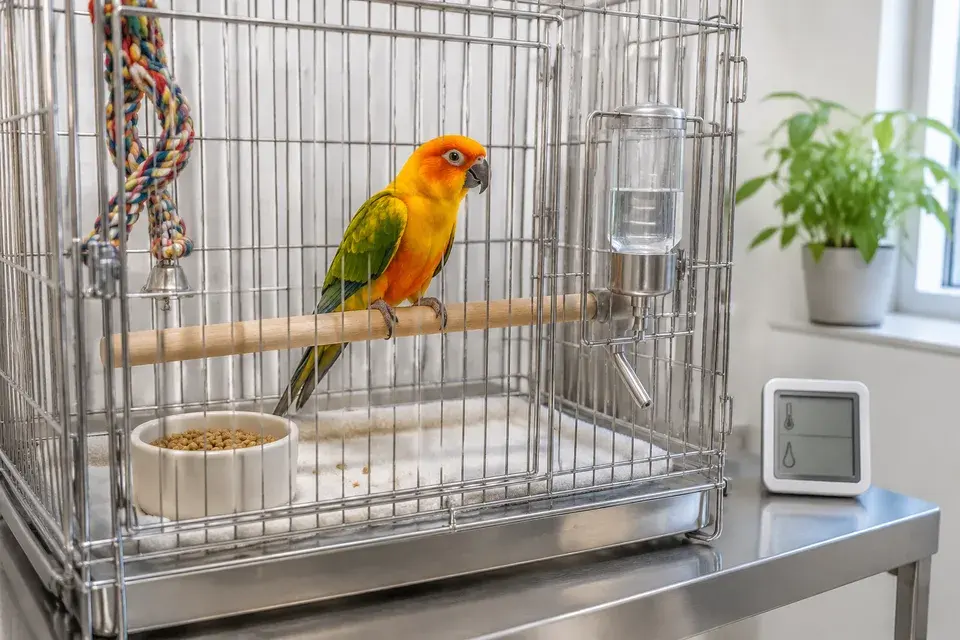
- Separate room & separate air return if possible: House the newcomer behind a closed door at the far end of the home, ideally in an easy-to-sanitize quarantine wire cage.
- Feed and clean your resident bird FIRST, newcomer LAST: Always tend established birds before entering the quarantine room. Wear a washable smock or change shirts and scrub hands up to the elbows afterward.
- Zero shared bowls, sponges, or perches: Soak quarantine stainless steel bowls in a separate sink or bathroom basin—never alongside your resident bird's dishes.
2. Recommended Avian Vet Quarantine Lab Panel
| Pathogen / Screen | Why Visual Checks Miss It | High-Priority Species |
|---|---|---|
| PBFD (Psittacine Circovirus PCR) | Latent viral shedding occurs weeks before dystrophic feathers appear | Lovebirds, budgies, cockatoos, African Greys, eclectus |
| Chlamydia psittaci (PCR / Choanal-Cloacal Swab) | Stress of moving home reactivates silent shedding; zoonotic to humans | Cockatiels, conures, Amazons, budgies |
| Fecal Wet Mount & Gram Stain | Detects budding Candida yeast, Macrorhabdus, Giardia, and bacterial overgrowth | All newly acquired chicks and pet-store birds |
| Avian Bornavirus (PaBV) | Long incubation window before crop slowdown or undigested seed in droppings (Rubbenstroth et al., 2022) | Macaws, cockatoos, conures, cockatiels |
3. Four-Phase Flock Introduction After Quarantine Clears
Once your vet clears lab work and 30–45 days pass with stable weight (see first-week weight tracking and our Quarantine Care Guide), never toss two birds into one cage:
- Week 1 — Visual Distance Across the Room: Place cages 2–3 meters apart so both birds observe body language while feeling 100% secure behind their own bars.
- Week 2 — Side-by-Side Cages (With a 15 cm Toe-Bite Gap!): Never push cages flush together—territorial parrots frequently bite toes through adjacent bars.
- Week 3 — Shared Positive Experiences in Neutral Territory: Bring both birds onto separate tabletop training stands in a neutral room while eating high-value millet or palm-leaf foraging bags simultaneously. Research on companion parrots (Meehan et al., 2003) shows compatible social companionship markedly lowers stereotypy when paired gradually.
- Keep separate sleeping cages long-term unless truly bonded: Even friendly flockmates appreciate independent roosting space at night.

Frequently Asked Questions
What if the two birds call back and forth through closed doors during quarantine?
Vocalizing across rooms is normal; play gentle background music near the quarantine door so contact calls don't escalate into frantic attention screaming.
Can I house a male and female parrot together right away?
Opposite-sex cage sharing often triggers intense seasonal hormonal nesting and egg-laying risks; separate cages with supervised shared playtimes are far safer for pet homes.